Thursday, February 14, 2013

Who really makes things happen

Steve Hayward discusses a friend and some intellectual interests in this short piece.  I understand the cultural distinctions between the various types of individuals discussed in these findings however there appears to be a missing link that goes unmentioned.  That missing link is what perceptive economists would call the entrepreneurial factor.  Without entrepreneurs capitalism would not exist because it is they who take the risks, bring capital and labor together and put simply, "make things happen".  Think Henry Ford, Bill Gates, Steve Jobs and thousands upon thousands of other risk takers whose foresight, intuition, and drive have resulted in companies that hire everyone who works in commerce for a living. These people clearly fall only in the first category of types discussed by the Cultural Cognition theory Hayward refers to.  The other three categories mentioned are out there but not really relevant to any discussion of what works in an economy to bring rising incomes and wealth to a society.  Unfortunately intellectuals always seem to overlook this perspective and for that reason in many instances promote solutions to economic issues that don't work or are counterproductive.  The capitalist system depends on the energy and risk taking of entrepreneurs.  Subvert these individuals and you get the kind of economy Obama wants which does not grow or create wealth.


THE ROOTS OF POLARIZATION?

So this is another of my occasional highly idiosyncratic posts, like previous ones on Progressive Rock, that is difficult to categorize and present.  I’ve been talking lately with one of my moderate liberal friends, David Ropeik.  He doesn’t like it when I call him a liberal because he is not a partisan, but I don’t mean it as a pejorative, insult or provocation.  He would surely seem a liberal to most readers of this site, but if more liberals were like him, the world would be a better place.  I like David very much personally and I often find him very sensible.  In fact, I posted a video conversation with him here about 18 months ago on risk assessment, about which he is very sound.
Lately David has been giving a lot of thought—perhaps too much thought in some ways—about a favorite subject of everyone these days: political polarization in America. He has written a long blog post at BigThink.com about the historic roots of polarization.  I think he’s been too ambitious and complicated here, and I can quarrel with some of his narrative.  However, I am quite keen on two of the frameworks he mentions—the Yale Cultural Cognition Project, which is based on the very useful analytical framework of the late Aaron Wildavsky (one of my academic heroes), and Jonathan Haidt’s social science work, which I’ve also mentioned favorably here before.
Some aspects of this have been on my mind because I’ve lately been trying to get my head around phenomenology, which I’ve always found baffling and largely incomprehensible, though I have a suspicion some of it may bear on this question of polarization and what David calls our “tribal instincts.”  David’s whole post is worth a read if you have the leisure, but here’s one snippet to give the flavor, along with a BigThink video of him below discoursing about the background of related issues.  Now go easy Powerliners!  David is a pal and I want to keep him a pal!
Research on the theory of Cultural Cognition has found that our views on issues of the day are in fact only reflections of deeper worldviews about the basic way we prefer society to operate. We adopt views on various issues based not just on the facts but so our views align with those of the groups with which we most closely identify. This helps us feel safe, since as social animals we depend on our group, our tribe, literally for our safety and survival. Agreeing with the group maintains us as a protected member in good standing. And if everyone in our group agrees, that social unity increases our group’s influence in the competition with other tribes for setting society’s rules. The more powerful and successful our group is, the safer we feel.
Cultural Cognition identifies four basic groups;
  • Individualists, who prefer a society that maximizes individual freedom and choice and control. (They prefer less government, i.e. “socialism”.)
  • Communitarians, who prefer a ‘we’re all in it together’ society that sacrifices some personal liberty in the name of the greater common good. (They prefer a more active role for government.)
  • Hierarchists, who prefer a traditional and unchanging society operating by fixed and commonly accepted hierarchies of social and economic class. (They prefer less government butting in and making things fair.)
  • Egalitarians, who prefer a more flexible society, unconstrained by traditional fixed hierarchies. (They prefer more government, as an engine of social and economic equity.)
The influence of these underlying worldviews on how we feel about individual issues is profound. Cultural Cognition research has found that these basic group identities are more accurate predictors of our positions on many of the contentious issues of the day than political affiliation, education, religion, or any of the more common demographic identifiers.

Sunday, February 10, 2013

Speaking truth to power

Dr. Ben Carson's "talk" at the National Prayer Breakfast one week ago is a major put down of the Progressive philosophy and governance for the last 60 years.  The irony of this put down was the presence of Obama sitting five feet away from Dr. Carson.  Carson's life is a revelation, which is detailed in this article that follows.  There is really not much else that needs to be said about Obama, his "progressive" administration, including of course Obamacare and all the rest, beyond this very brief presentation made by Dr. Carson.  It becomes painfully obvious that the Democrats/progressives/socialists do not have any answers to the problems or opportunities in our society today or any other time in history.  Doctor Carson said it all at this event.  We have been victimized as a society by the aforementioned and there is little we can do at this point in time except suffer the consequences of all the misguided programs and policies, pick up the pieces after the storm is over, and reconstruct our way of life.  There are difficult times ahead.

February 10, 2013

A Perfect Contrast

By William Sullivan
Contrast can bring clarity. And I do not think that the two warring political ideologies in America have never been personified, juxtaposed, and as clearly defined as the contrast we witnessed at this week's National Prayer Breakfast.
Dr. Benjamin Carson, the famed director of pediatric neurosurgery at Johns Hopkins University, was given the unique opportunity to share his beliefs before a distinguished audience, including President Barack Obama. He did not waste the opportunity, and courageously expressed his beliefs with conviction, contrary though they are to those of the president.
Much has been made of Dr. Carson's alternative solution to make healthcare more efficient:
Here's my solution: When a person is born, give him a birth certificate, an electronic medical record, and a health savings account to which money can be contributed - pretax -- from the time you're born 'til the time you die. When you die, you pass it on to your family members, so that when you're 85 years old and you got six diseases, you're not trying to spend up everything. You're happy to pass it on and there's nobody talking about death panels.
Number one. And also, for the people who were indigent who don't have any money we can make contributions to their HSA every month because we already have this huge pot of money. Instead of sending it to some huge bureaucracy, let's put it in their HSAs. Now they have some control over their own healthcare.
We must admit -- there is something amazing about this. In two paragraphs, Ben Carson has offered a free market solution to create competition and reduce healthcare costs that is feasible, understandable, and compassionate. (And one that has already been tested -- it is very similar to the system used in Singapore. ) Its relative simplicity alone stands in stark contrast to Obama's healthcare solution pitch, the mechanics of which were so confusing that after two years of explaining it, Democrats entreated Americans to not even try to understand it. Just accept it and see what happens, as Nancy Pelosi suggested.
But to focus on the contrast between their healthcare approaches alone is to miss the deeper contrast on display. That is, the contrast between Dr. Ben Carson and Barack Obama, the ideologies that have driven their life's work, and the results of that work.
Years ago, I remember my mother asking if I had ever heard of Dr. Ben Carson. She explained that he was a pioneer in neurological medicine, and that he had an amazing and inspiring story. She had a copy of Dr. Carson's book, Gifted Hands, and began to read passages that she had selected. I was captivated, committed to reading more about him, and later watched the film of the same title starring Cuba Gooding, Jr. Indeed, his story is one of the most amazing and inspiring I'd ever heard, from his unique upbringing to his design of a groundbreaking procedure in 1987 which successfully separated two cranially conjoined twin babies. His life, his work, is nothing short of miraculous.
Dr. Ben Carson was one of two sons born to Sonya Carson, a single mother who had married Ben's father at thirteen years of age. Ben's father was a bigamist, and after learning of his other family, Sonya resolved to raise her two sons alone. Though in poverty, and though she herself had no formal education beyond third grade, she insisted that her sons devote diligent efforts to their education. She required that the boys read books from the public library each week and write lengthy reports for her (which she would review for them to support their effort, despite being unable to read). She worked hard to support them financially, in staunch determination that she would not be a victim, and neither would her children. In short, the Carson family is a testament to personal perseverance and the success that follows.
One story of Dr. Carson's childhood that particularly stood out to me is an instance where he, an admittedly angry child, attempted to stab his friend in the stomach, only to have the blade of the knife blocked and broken by the other child's belt buckle. This was a moment that shaped his worldview thereafter, and he has expressed a belief that it was divine intervention. And I could not help but agree. Could it be anything but Providence that this good fortune, without which he may have been incarcerated and set on a different path, became the good fortune of the world, allowing Dr. Carson to touch and save so many lives?
Knowing of his background, it came as no surprise when I reviewed the entire speech at the National Prayer Breakfast that nearly everything Ben Carson said was a perfect contradiction of the values expressed by Barack Obama.
Dr. Carson began his speech, even as he shared the stage with the world's most renowned spokesman for political correctness, by decrying political correctness as a "dangerous" concept. He argued that political correctness acts as a "muzzle," keeping people from "discussing important issues while the fabric of their society is being changed," even as the architect of that "change" sat just a few feet to his right.
He related the admirable tale of his mother's unwillingness to be a victim, as he was in the presence of our president who unequivocally demands that women in such circumstances be viewed and treated as such. Dr. Carson told the audience about his revelation that poverty is a "temporary" condition, one which people could personally alter. And he said this in the presence of a man whose political ideology is founded upon the notion that poverty is an institutionally applied condition, and that it is the responsibility of society, not the individual, to alter that condition.
Dr. Carson went on to destroy the notion of the progressive income tax, arguing that "God has given us a system" that would work. He argued that because God requires tithing regardless of outcome:
There must be something inherently fair in proportionality. If you make ten billion dollars, you put in one billion. If you make ten dollars, you put in one. Of course you gotta get rid of the loopholes. [Laughter] But, now some people say, "Well that's not fair, because it doesn't hurt the guy who made ten billion dollars as much as the guy who made ten." Where does it say you have to hurt the guy? He just put a billion dollars in the pot!
Is it possible to say anything more contrary to Barack Obama's insistence on the moral imperative to take disproportionately more from the wealthy to redistribute among the collective?
And this is where the contrast between the two men becomes most apparent. Barack Obama rejects the notion of fairness presented by God, because his devotion to God, if it was ever a driving motivation in his life, has become supplanted by his devotion to the government administration of fairness. That much is abundantly clear. Consider that Dr. Carson carries himself with a pious humility, crediting God and family for giving him the strength of will to succeed. President Obama, whose name would rarely collide with humility in a sentence, insists that the government is responsible for people's success.
The revelation here is not that Barack Obama is a PC thug who intends to transform the fabric of America, or that he makes victims of women rather than empowering them, or that he subscribes to a Marxist's notion of fairness by coercion, or that his healthcare solution is a muddled, hopeless mess sold on Utopian dreams. We already knew all that.
No, the real revelation is that at this year's prayer breakfast, so often only a pious ritual, his exact opposite stood and spoke in sharp contrast to our president. And Dr. Ben Carson owns a legacy as an innovative pioneer of his field and philanthropist whose life and work have personally touched, and even saved, countless others. Barack Obama, on the other hand, despite all his celebrity, owns a legacy that amounts to little more than stirring fear and outrage on the premise that others are not doing enough to help people.
Which ideology has produced the more effective, positive outcome?


Read more: http://www.americanthinker.com/2013/02/a_perfect_contrast.html#ixzz2KWj0wpez 
Follow us: @AmericanThinker on Twitter | AmericanThinker on Facebook 

Thursday, February 7, 2013

How Austrian economics is right


A
A
[This talk was delivered on January 26, 2013, at the Jeremy S. Davis Mises Circle in Houston, Texas.]
In December, it will be 100 years since Congress authorized the creation of the Federal Reserve System. Throughout that century the Fed has enjoyed broad bipartisan support. That’s another way of saying the Fed never appeared on the political radar until Ron Paul broke the rules by actually campaigning against it in 2007.
The Fed was supposed to provide stability to the financial sector and the economy at large. We are supposed to believe it has been a wonderful success. A glance at the headlines over the past five years renders an unkind verdict on this rarely examined assumption.
Last year we observed another important centenary—the 100-year anniversary of the publication of Ludwig von Mises’s pathbreaking book, The Theory of Money and Credit, written when the great economist was just 31. The end of an era was approaching as that book reached the public. A century of sound money, albeit with exceptions here and there, was drawing to a close. It had likewise been a century of peace, or at least without a continent-wide war, since the Congress of Vienna. Both of these happy trends came to an abrupt end for the same reason: the outbreak in 1914 of World War I, the great cataclysm of Western civilization.
It was as though Mises had one eye to the past, speaking of the merits of a monetary system which—while not perfectly laissez-faire—had served the world so well for so long, and another eye to the future, as he warned of the consequences of tampering with or abandoning that system. Mises carefully dismantled the inflationist doctrines that were to ravage much of the world during the twentieth century.
The book covered the whole expanse of monetary theory, including money and its origins, interest rates, time preference, banking, credit, inflation, deflation, exchange rates, and business cycles.
Most important for our topic today was Mises’s warning to the world’s monetary authorities not to suppress the market rate of interest in the name of creating prosperity. The failure to heed Mises’s advice, indeed the full-fledged ignorance or outright defiance of that advice, is the monetary story of the twentieth century.
The single most arresting economic event of the Fed’s century was surely the Great Depression. This was supposed to have discredited laissez-faire and the free economy for good. Wild speculation was said to have created a stock-market bubble, and the bust in 1929 was what the unregulated market had allegedly wrought. Other critics said the problem had been the free market’s unfair distribution of wealth: the impoverished masses simply couldn’t afford to buy what the stores had for sale. In later years, even so-called free-marketeers would blame the Depression on too little intervention into the market by the Federal Reserve. (With friends like these, who needs enemies?)
Ludwig von Mises offered a different explanation, as did F.A. Hayek, Lionel Robbins, and other scholars working in the Austrian tradition in those days. Murray N. Rothbard, in turn, would devote his 1962 book America’s Great Depression to an Austrian analysis of this misunderstood episode.
The study of business cycles differs from the study of economic hard times. Economic conditions can be poor because of war, a natural disaster, or some other calamity that disrupts the normal functioning of the market. Business cycle research is not interested in those kinds of conditions. It seeks to understand economic boom and bust when none of these obvious factors are present.
Mises referred to his own approach as the circulation credit theory of the business cycle. For our purposes, we can describe it in brief.
On the free market, when people increase their saving, that increased saving has two important consequences. First, it lowers interest rates. These lower interest rates, in turn, make it possible for entrepreneurs to pursue a range of long-term investment projects profitably, thanks to the lower cost of financing. Second, the act of saving and thus abstaining from spending on consumer goods, releases resources that these entrepreneurs can use to complete their new projects. If consumer-goods industries no longer need quite so many resources, since (as we stipulated at the start) people are buying fewer consumer goods, those released resources provide the physical wherewithal to carry out the long-term production projects that the lower interest rates encouraged entrepreneurs to initiate.
Note that it is decisions and actions by the public that provide the means for this capital expansion. "If the public does not provide these means," Mises explains, "they cannot be conjured up by the magic of banking tricks."
But "banking tricks" are precisely how the Fed tries to stimulate the economy. The Fed lowers interest rates artificially, without an increase in saving on the part of the public, and without a corresponding release of resources. The public has not made available the additional means of production necessary to make the array of long-term production projects profitable. The boom will therefore be abortive, and the bust becomes inevitable.
In short, interest rates on a free market reflect people’s willingness to abstain from immediate consumption and thereby make resources available for business expansion. They give the entrepreneur an idea of how far, and in what ways, he may expand. Market interest rates help entrepreneurs distinguish between projects that are appropriate to the current state of resource availability, and projects that are not, projects that the public is willing to sustain by its saving and projects that they are not.
The central bank confuses this process when it intervenes in the market to lower interest rates. As Mises put it:
The policy of artificially lowering the rate of interest below its potential market height seduces the entrepreneurs to embark upon certain projects of which the public does not approve. In the market economy, each member of society has his share in determining the amount of additional investment. There is no means of fooling the public all of the time by tampering with the rate of interest. Sooner or later, the public’s disapproval of a policy of over-expansion takes effect. Then the airy structure of the artificial prosperity collapses.
None of these cycles will be exactly like any other. Roger Garrison says the artificial boom will tend to latch on to and distort whatever the big thing at the time happens to be—tech stocks in the 1990s, for example, and housing in the most recent boom.
With this theoretical apparatus as a guide, Mises became convinced as the 1920s wore on that the seeds of a bust were being sown. This was not a fashionable position. Irving Fisher, a godfather of modern neoclassical economics and the man Milton Friedman called the greatest American economist, could see nothing but continued growth and prosperity in his own survey of economic conditions at the time. In fact, Fisher’s predictions in the late 1920s, even in the very midst of the crash, are downright embarrassing.
On September 5, 1929, Fisher wrote: "There may be a recession in stock prices, but not anything in the nature of a crash … the possibility of which I fail to see."
In mid-October, Fisher said stocks had reached a "permanently high plateau." He expected "to see the stock market a good deal higher than it is today within a few months." He did "not feel that there will soon, if ever, be a fifty- or sixty-point break below present levels."
On October 22 Fisher was speaking of "a mild bull market that will gain momentum next year." With the stock market crashing and values plummeting all around him—with declines far more severe than Fisher had been prepared to admit were even conceivable—Fisher on November 3 insisted that stock prices were "absurdly low." But they would go much lower, ultimately losing 90 percent of their peak value.
What had gone so horribly wrong? Fisher and his colleagues had been blinded by their assumptions. They had been looking at the "price level" and at economic growth figures to determine the health of the economy. They concluded that the 1920s were a period of solid, sustainable economic progress, and were taken completely by surprise by the onset and persistence of the Depression.
Mises, on the other hand, was not fooled by the 1920s. For Mises and the Austrians, crude aggregates of the kind Fisher consulted were not suitable for ascertaining the condition of the economy. To the contrary, these macro-level measurements concealed the economy-wide micro-level maladjustments that resulted from the artificial credit expansion. The misdirection of resources into unsustainable projects, and the expansion or creation of stages of production that the economy cannot sustain, do not show up in national income accounting figures. What matters is that interest rates were pushed lower than they would otherwise have been, thereby leading the economy into an unsustainable configuration that had to be reversed in a bust.
Thus Mises wrote in 1928:
It is clear that the crisis must come sooner or later. It is also clear that the crisis must always be caused, primarily and directly, by the change in the conduct of the banks. If we speak of error on the part of the banks, however, we must point to the wrong they do in encouraging the upswing. The fault lies, not with the policy of raising the interest rate, but only with the fact that it was raised too late.
Once the crisis hit, Mises showed how his theory of business cycles accounted for what was happening. If people could understand how the crash had come about, Mises hoped, they would be less likely to exacerbate the problem with counterproductive government policy.
"The Causes of the Economic Crisis" was the title of an address Ludwig von Mises delivered in late February 1931 to a group of German industrialists. It was unknown to English-speaking audiences until 1978, when it was published as a chapter in a collection of Mises’s essays called On the Manipulation of Money and Credit. The Mises Institute published a new edition of these essays in 2006 under the title The Causes of the Economic Crisis: And Other Essays Before and After the Great Depression.
In that essay Mises was characteristically blunt in describing the causes of the Great Depression, as well as in his warnings that such crises would recur as long as the authorities continued to pursue the same destructive courses of action.
The crisis from which we are now suffering is … the outcome of a credit expansion. The present crisis is the unavoidable sequel to a boom. Such a crisis necessarily follows every boom generated by the attempt to reduce the "natural rate of interest" through increasing the fiduciary media [in other words, through creating credit out of thin air].
As we have seen at this event today, the crisis whose wreckage we see all around us right now, a crisis that began in 2008, originated from the same interventions Mises warned against a century ago. Mises would not have been surprised by the Panic of 2008. In 1931, he warned of a recurrence of boom-bust cycles if the policy of artificially low interest rates was not abandoned:
The appearance of periodically recurring economic crises is the necessary consequence of repeatedly renewed attempts to reduce the "natural" rates of interest on the market by means of banking policy. The crises will never disappear so long as men have not learned to avoid such pump-priming, because an artificially stimulated boom must inevitably lead to crisis and depression. …
All attempts to emerge from the crisis by new interventionist measures are completely misguided. There is only one way out of the crisis. … Give up the pursuit of policies which seek to establish interest rates, wage rates, and commodity prices different from those the market indicates.
In the 1920s as now, fashionable opinion could see no major crisis coming. Then as now, the public was assured that the experts at the Fed were smoothing out economic fluctuations and deserved credit for bringing about unprecedented prosperity. And then as now, when the bust came, the free market took the blame for what the Federal Reserve had caused.
It is fitting that a century of the Federal Reserve should come to an end at a moment of economic crisis and uncertainty, with the central bank’s leadership confused and in disarray after the economy’s failure to respond to unprecedented doses of monetary intervention. The century of the Fed has been a century of depression, recession, inflation, financial bubbles, and unsound banking, and its legacy is the precipice on which our economy now precariously rests.
Faced with a slow-motion train wreck they feel helpless to stop, people often ask what they can do.
There are no easy answers, to be sure. But one thing is certain: there will be no progress without the spread of knowledge.
I hope you’ll be a part of the crucial and historic moment that lies before us.
Thanks in large part to Ron Paul, recent years have seen a spectacular revival of interest in the Austrian School of economics and in particular its theory of the business cycle. This is a deeply significant and most welcome development. Until recently, even supporters of the free market had by and large ignored the Federal Reserve, or even thought of it as a potentially stabilizing force in a capitalist economy. The possibility that its interventions into the market may actually have been destabilizing, and actually have been the cause of the boom-bust cycle, was hardly to be heard anywhere. Were you to say such a thing at an ostensibly free-market conference, chances were slim that you would appear on the following year’s program.
For more than 30 years, however, the Mises Institute has been dedicated to the pursuit of economic science in the Austrian tradition. We’ve warned against the economic damage caused by central banking at a time when that message couldn’t have been less fashionable. You’ve already seen some of the results of our work here this weekend: three of our speakers—Peter Klein, Bob Murphy, and Tom Woods—came through the Institute’s programs during their college years.
But now, with the vastly increased demand for what we offer, we want to step things up. Way up.
One of our primary goals is to carry out what we’re calling Operation Ron Paul. We want to equip the masses of young people drawn to the Austrian School by Ron’s heroic work with the skills, resources, and knowledge they’ll need in order to keep the Austrian School and Ron’s message vital and growing.
We are also setting up an Economic Crisis Project, to be ready now and when the next event hits, with the scholarly and popular explanations of what happened, and what to do about it.
What is attractive about the market economy is not simply what it accomplishes materially: ever-higher standards of living, prosperity for the masses that the most exalted monarchs of yore could scarcely have imagined for themselves, and the ability to support far larger populations than anyone centuries ago could have dreamed. This is all great cause for celebration, to be sure. But what the beautiful order of the market shows is the staggering, near-miraculous achievements of mankind by means of voluntary cooperation, and without state violence or an exalted leader ordering people around.
Set against this marvelous spectacle, the government-privileged central bank is a grotesque anomaly. To say that we need a politically created monopoly to create money, the commodity that constitutes one-half of every non-barter transaction, is to say that the market economy is not really so impressive or effective after all. If we must conjure a specially privileged monopoly to create this most essential commodity, and if that monopoly is likewise given the task of managing the economy to maximize employment and output, then we are in principle abandoning the whole case for the free market and conceding the value of central planning.
We do not need any such monopoly, as the work of the Austrian economists makes clear, and we do not need any form of central planning. We need the free market, which is another way of saying we need to let people make their own decisions, enter into the agreements of their choice, and be secure in their private property.
The Austrian School is enjoying its most spectacular surge in growth in its entire history. A generation of smart young people are reading everything they can find on Austrian economics. The Austrian diagnosis of the economic crisis is so widespread that even establishment writers and economists have been forced to engage with it.
Let’s make sure this surge doesn’t fizzle out. If we build on these early successes, if we carry forward the message of the Austrian School relentlessly and courageously, we can make the next hundred years a Misesian century of peace, sound money, and liberty. Please join us.

Sunday, February 3, 2013

Do we need the income tax?


Do we need the income tax to manage a modern society?  This is a valid and important question that is addressed here by Dan Mitchell.  He's right that the more revenue the state takes in, the more politicians have to redistribute and buy votes to keep themselves in office.  Clearly increasing revenues means bigger government, and bigger government means more laws and regulations and control over the individual's life.  Either you want a society in which individual responsibility and freedom are paramount, or you don't.  There's no compromising in this issue.  

The 100th Anniversary of the Income Tax…and the Lesson We Should Learn from that Mistake

What’s the worst thing about Delaware?
No, not Joe Biden. He’s just a harmless clown and the butt of some good jokes.
Instead, the so-called First State is actually the Worst State because 100 years ago, on this very day, Delaware made the personal income tax possible by ratifying the 16th Amendment.
Though, to be fair, I suppose the 35 states that already had ratified the Amendment were more despicable since they were even more anxious to enable this noxious levy (and Alabama was first in line, which is a further sign that Georgia deserved to win the Southeastern Conference Championship Game, but I digress).
Let’s not get bogged down in details. The purpose of this post is not to re-hash history, but to instead ask what lessons we can learn from the adoption of the income tax.
The most obvious lesson is that politicians can’t be trusted with additional powers. The first income tax had a top tax rate of just 7 percent and the entire tax code was 400 pages long. Now we have a top tax rate of 39.6 percent (even higher if you include additional levies for Medicare and Obamacare) and the tax code has become a 72,000-page monstrosity.
But the main lesson I want to discuss today is that giving politicians a new source of money inevitably leads to much higher spending.
Here’s a chart, based on data from the Office of Management and Budget, showing the burden of federal spending since 1789.
Since OMB only provides aggregate spending data for the 1789-1849 and 1850-190 periods, which would mean completely flat lines on my chart, I took some wild guesses about how much was spent during the War of 1812 and the Civil War in order to make the chart look a bit more realistic.
But that’s not very important. What I want people to notice is that we enjoyed a very tiny federal government for much of our nation’s history. Federal spending would jump during wars, but then it would quickly shrink back to a very modest level – averaging at most 3 percent of economic output.
Federal Spending 1789-2012
So what’s the lesson to learn from this data? Well, you’ll notice that the normal pattern of government shrinking back to its proper size after a war came to an end once the income tax was adopted.
In the pre-income tax days, the federal government had to rely on tariffs and excise taxes, and those revenues were incapable of generating much revenue for the government, both because of political resistance (tariffs were quite unpopular in agricultural states) and Laffer Curve reasons (high tariffs and excise taxes led to smuggling and noncompliance).
But once the politicians had a new source of revenue, they couldn’t resist the temptation to grab more money. And then we got a ratchet effect, with government growing during wartime, but then never shrinking back to its pre-war level once hostilities ended (Robert Higgs wrote a book about this unfortunate phenomenon).
The same thing happened in Europe. The burden of government spending used to be quite modest on the other side of the Atlantic, with outlays consuming only about 10 percent of economic output.
Once European politicians got the income tax, however, that also enabled a big increase is the size of the state.
But Europe also gives us a very good warning about the dangers of giving politicians a second major source of revenue.
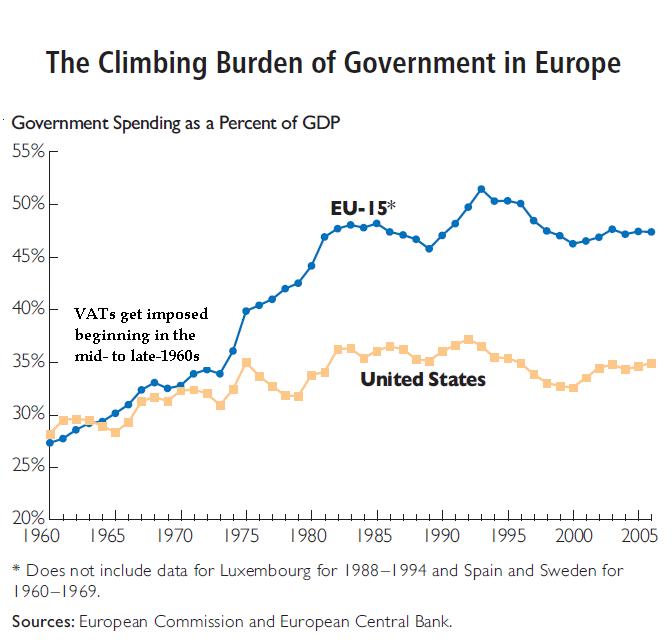
Here’s a chart I prepared for a study published when I was at the Heritage Foundation. You’ll notice from 1960-1970 that the overall burden of government spending in Europe was not that different than it was in the United States.
That’s about the time, however, that the European governments began to imposevalue-added taxes.
The rest, as they say, is history.
VAT and Govt Spending in EU
I’m not claiming, by the way, that the VAT is the only reason why the burden of government spending expanded in Europe. The Europeans also impose harsher payroll taxes and higher energy taxes. And their income taxes tend to be much more onerous for middle-income households.
But I am arguing that the VAT helped enable bigger government in Europe, just like the income tax decades earlier also enabled bigger government in both Europe and the United States.
So ask yourself a simple question: If we allow politicians in Washington to impose a VAT on top of the income tax, do you think they’ll use the money to expand the size and scope of government?
If it takes more than three seconds to answer that question, I suggest you emigrate to France as quickly as possible.
P.S. You probably won’t be surprised to learn that the crazy bureaucrats at the Paris-based OECD think the VAT is good for growth and jobs. Sort of makes you wonder why we’re subsidizing those statists with American tax dollars.

Henry Morganthau and The Great Depression

From Jim Taranto's column comes this bit of nonsense about messaging and vision and transformation and on and on. It's hard to know where to begin to comment on the thoughts expressed here because they are so confused and lacking in relevance.  For example some commenter makes the point Obama compares unfavorably to FDR for "failing to single out "villains" including "Wall Street gamblers", "conservative extremists"and George W. Bush ...".  What's wrong with this "observation", at least to those of us who have read historians other than those who deified FDR and his misguided New Deal, is the fact that by any reasonably thought out standards, the New Deal was a colossal failure.  Consider this 1939 quote (10 years after the Crash of 1929 and the onset of the Great Depression) from one of its architects and key administrators, Secretary of the Treasury Henry Morgenthau:


“We have tried spending money. We are spending more than we have ever spent before and it does not work. And I have just one interest, and now if I am wrong somebody else can have my job. I want to see this country prosper. I want to see people get a job. I want to see people get enough to eat. We have never made good on our promises. I say after eight years of this administration, we have just as much unemployment as when we started. And enormous debt to boot.”
So, dingbat commenters think Obama should model himself after a president whose policies prolonged the Great Recession into a ten-year nightmare and like FDR should demonize his opponents more in order to rally the American people more to his cause.  Anyone who can to explain the logic of this thinking deserves an advanced degree in philosophy.

Jim Taranto comments:
Drew Westen, a psychologist cum political tactician, who in a lengthy and much-discussed (including in this column) New York Times op-ed faulted the president for having failed to tell "a story the American people were waiting to hear--and needed to hear." Westen compared Obama unfavorably to FDR, faulting him for failing to single out "villains" including "Wall Street gamblers," "conservative extremists" and George W. Bush and for not beginning his presidency by making clear his intention to steamroll congressional Republicans, back when that was an option. In response, Time's Joe Klein enthused:
Obama is often eloquent. . . . But he has never deployed these skills in service of the larger story--never really explained where we are as a country, how we got here and--Westen is spot on here--who the villains have been. He has never gone to war on behalf of the American people. . . .
[Obama and Jimmy Carter] do share a trait: an inability to tell a story. The most popular stories have good guys and bad guys. If he wants to be re-elected, Obama is going to have to start telling us who the bad guys are and what he plans to do about them.
Obama won re-election, but would anyone really describe the 2012 Obama campaign as a clinic in exegetical politics? Did Obama lay out a compelling case for his principles? Far from it. In fact, his clearest ideological statement was "You didn't build that." His supporters spent weeks insisting he didn't say that.
What Obama did do successfully was vilify his opponent ("not one of us") and make narrow, often fear-based appeals to particular interest groups. His campaign also demonstrated a mastery of technology for identifying voters and coaxing them to the polls.

Taranto concludes:  So maybe conservatives should snap out of it. If the left emerged triumphant from the slough of despond in barely a year, there's no reason the right can't do it too. But it's no clearer now than it was then that the answer lies in better "messaging." (Incidentally, maybe if you want to message good, you shouldn't use nouns as verbs.) And talking about the need for better messaging isn't going to win any elections. To be sure, neither is writing about talking about messaging. But we promise never to run for anything.