Beginning two decades after the death of Franklin Roosevelt, who would find today’s government unrecognizable, government became a geyser of entitlements. In 2010, government at all levels transferred more than $2.2 trillion in money, goods and services to recipients — $7,200 per individual, almost $29,000 per family of four. Before 1960, only in the Depression years of 1931 and 1935 did federal transfer payments exceed other federal expenditures. During most of FDR’s 12 presidential years, income transfers were a third or less of federal spending. But between 1960 and 2010, entitlements exploded from 28 percent to 66 percent of federal spending. By 2010, more than 34 percent of households were receiving means-tested benefits. Republicans were more than merely complicit, says Eberstadt:“The growth of entitlement spending over the past half-century has been distinctly greater under Republican administrations than Democratic ones. Between 1960 and 2010, the growth of entitlement spending was exponential — but in any given year, it was on the whole over 8 percent higher if the president happened to be a Republican rather than a Democrat. . . . The Richard Nixon, Gerald Ford and George W. Bush administrations presided over especially lavish expansions of the entitlement state.”Why, then, should we expect Romney to reverse Republican complicity? Because by embracing Paul Ryan, Romney embraced Ryan’s emphasis on the entitlement state’s moral as well as financial costs.As evidence of the moral costs, Eberstadt cites the fact that means-tested entitlement recipience has not merely been destigmatized, it has been celebrated as a basic civil right. Hence the stunning growth of supposed disabilities. The normalization and then celebration of dependency help explain the “unprecedented exit from gainful work by adult men.”Since 1948, male labor force participation has plummeted from 89 percent to 73 percent. Today, 27 percent of adult men do not consider themselves part of the workforce: “A large part of the jobs problem for American men today is not wanting one.” Which is why “labor force participation ratios for men in the prime of life are lower in America than in Europe.”One reason work now is neither a duty nor a necessity is the gaming — defrauding, really — of disability entitlements. In 1960, an average of 455,000 workers were receiving disability payments; in 2011, 8.6 million were — more than four times the number of persons receiving basic welfare benefits underTemporary Assistance for Needy Families. Nearly half of the 8.6 million were “disabled” because of “mood disorders” or ailments of the “musculoskeletal system and the connective tissue.” It is, says Eberstadt, essentially impossible to disprove a person’s claim to be suffering from sad feelings or back pain.“In 1960,” Eberstadt says, “roughly 134 Americans were engaged in gainful employment for every officially disabled worker; by December 2010 there were just over 16.” This, in spite of the fact that public health had improved much, and automation and the growth of the service/information economy had made work less physically demanding. Eberstadt says collecting disability is an increasingly important American “profession.”For every 100 industrial workers in December 2010, there were 73 “workers” receiving disability payments. Between January 2010 and December 2011, the U.S. economy created 1.73 million nonfarm jobs — but almost half as many (790,000) workers became disability recipients. This trend is not a Great Recession phenomenon: In the 15 years ending in December 2011, the United States added 8.8 million nonfarm private sector jobs — and 4.1 million workers on disability rolls.The radiating corruption of this entitlement involves the collaboration of doctors and health care professionals who certify dubious disability claims. The judicial system, too, is compromised in the process of setting disability standards that enable all this.America’s ethos once was what Eberstadt calls “optimistic Puritanism,” combining an affinity for personal enterprise with a horror of dependency. Nov. 6 is a late and perhaps last chance to begin stopping the scandal of plundering our descendants’ wealth to finance the demands of today’s entitlement mentality.
Sunday, October 28, 2012
The entitlement-welfare state is dead
George Will's Wapo column this week produced some frightening statistics that anyone considering a vote for Obama should study and think about the consequences of their vote. As Will points out the actual growth rate of the dependency culture entitlements has grown faster under Republican administrations than Democrat ones. Thus those of us who have reflexively voted Republican over the years on the grounds that while Republicans are also guilty of supporting big government policies, they were the lesser of two evils in that they didn't espouse as many big government programs as Democrats, have been wrong. As it turns out we have been on a path to collapse, at least in recent years, since Hoover and FDR launched government intervention in the market big time in the 1930s. It is painfully clear that we've reached the tipping point of the ability of the government to fund entitlements and the welfare state. Collectivism and the welfare state stop working when, as Margaret Thatcher said, "eventually socialists run out of other people's money". And so now we have to either tax the few with any wealth left to the point we are all equally poor, or we have to roll back the entitlement state, rekindle real capitalism and the incentives to work. While the Romney-Ryan ticket is Republican, one has to hope they mean it this time and do intend to reign in the welfare state, offer pro business incentives and let the free market provide opportunities for people to find work. There doesn't seem to be any other choice as Obama wants to continue expanding the role of government by taxing the rich. Here are a few choice stats from Will's article:


Outrage over events in Libya
Clarice Feldman, in this column, has captured the feelings of any Americans who have followed events in Libya. The behavior of all members of the Obama administration who had any responsibility for the deployment and safety of Americans serving their country in any capacity abroad, was simply unconscionable at every level. The outrage expressed in her column is exactly the appropriate response to the malfeasance of all the participants whose politically motivated action and inaction caused the unnecessary deaths of four Americans. No matter the outcome of the presidential race coming to a close, those responsible for this atrocious behavior should be exposed and publicly shamed, at the very least.
Saturday, October 27, 2012
A useful chart for investors
This is a useful chart:
Price to Earnings Ratio (PE ratio), 1900 to present

The PE ratio is a reasonable guide to the price of stocks. Generally speaking when PE ratios exceed the 10-15 range, that seems to be a pretty good indicator that we are getting into the froth area of a bull market and that it might be time to heavy up on cash.
Price to Earnings Ratio (PE ratio), 1900 to present
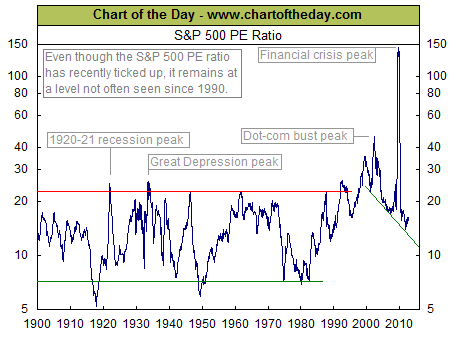
The PE ratio is a reasonable guide to the price of stocks. Generally speaking when PE ratios exceed the 10-15 range, that seems to be a pretty good indicator that we are getting into the froth area of a bull market and that it might be time to heavy up on cash.
Thursday, October 25, 2012
Economists or soothsayers?
This item below speaks to the arrogance and yes, stupidity, of many economists. Imagine someone trying to predict exact numerical outcomes in a complicated multifarious economy in which the key driver is the initiative of entrepreneurs? This arrogance (and stupidity) assumes they can read the minds of the movers and shakers like Steve Jobs, Steve Wynn, and thousands of other risk-takingindividuals who invest capital when they decide the conditions are conducive to making a profit. These realists surely do not imagine that government make-work and wild spending with freshly printed, unsaved dollars is going to magically turn the economy around and make things whole. And yet these academically trained wizards are presumed by naive politicians like Obama to have some magical crystal ball that tells them the truth. One wonders why today's politicians don't read up on what happened when Hoover and FDR tried to spend the country into prosperity after the crash of 1929 and the onset of The Great Depression. What should have been a one or two year depression turned into an eleven year nightmare.


If President Obama loses the election in November, economists may well end up taking a share of the blame – for good reason. Their models misled him into applying ambitious stimulus therapies to jump start the economy and boost employment that haven’t worked, vastly undermining his re-election prospects.
Back in January 2009, a now infamous study coauthored by Christina Romer, the future chair of the President Obama’s Council of Economic Advisors, and Jared Bernstein, the future chief economist for the Vice President, predicted that an $800 billion economic stimulus targeted toward boosting consumer demand would stave off a severe recession and hold unemployment below 8 percent by the end of 2009.
What was so compelling about their study was the illusion of precision. The Obama administration used their statistical analysis to aggressively promote specific policy proposals, including the package of tax cuts and discretionary federal spending embodied in the so-called stimulus package, the American Recovery and Reinvestment Act of 2009.
But little of what they predicted has panned out. . . . In short, in what is perhaps the most important exercise in economic policy modeling since the Great Depression, two of the nation’s foremost economists failed. And the failure was an epic one. They predicted that unemployment would peak at 8 percent after the stimulus. In fact it peaked at 9.9 percent. So it’s unclear whether trillions of dollars of stimulus spending bought the country any reduction in unemployment whatsoever. It’s also hard to escape the conclusion that it would have been better to do nothing and let the economy run its course.
Indeed. Here’s a reprise and update of that devastating graphic of what Obama promised vs. what he delivered.

And a look at the percentage of Americans who are employed, which still stinks:
CBS -- news or propaganda
CBS has been a suspect news organization since the days of Walter Cronkite and his anti war reporting on Vietnam. It was Cronkite who took news reporting from the facts to advocacy which the three major networks into promoters of liberalism. As this article articulates, CBS is so far in the tank for the liberals that they even withhold parts of interviews that may not fit the narrative du jour. What's frustrating about this state of affairs is the fact that the FAA, a government agency tasked with permitting these privately owned networks access to the public's airways, does not hold them accountable for this powerful advocacy journalism -- as it is supposed to. It is an established fact that journalists are overwhelmingly liberal and vote accordingly in elections. Again, were it not for the emergence of the internet, talk radio, and Fox News, conservatives would be trapped in the same prison of liberal ideas as those who watch CBS, CNN, ABC, NBC, and who are served by big city liberal papers like the Washington Post, NYTimes, LATimes and many others. While Republicans are out creating businesses that employ people and make the wheels of the economy turn, Democrats are busily doing their best to undermine the system in then guise of making nit more fair, or something. Still, the liberal paradigm has run its course. They have now run out of "other peoples' money" in pursuit of a level playing field and all the rest of the socialist dream world fantasies of the perfect society. Hopefully a Romney election can reverse the 80 year drift to more government, collectivism, and less individual freedom. Since the failure of the USSR provides a vivid example of where the liberal path eventually leads us, one has to wonder why so many want this solution.
Tuesday, October 23, 2012
The US in microcosm
What Austerity Looks Like
Bankrupt San Bernardino’s new, skeletal government
22 October 2012
Three interconnected forces brought the working-class, inland Southern California city of San Bernardino to insolvency: a burst housing bubble and lethargic economic growth; high police and firefighter salaries mandated by the city’s charter; and compounding pension obligations. Bankruptcy should give San Bernardino leverage to deal with the last two, but the big, structural changes required will not be easy or pleasant. Absent such changes, though, salaries and pensions will continue to grow faster than the city’s revenues, crowding out most other government functions and services. San Bernardino offers a telling illustration of austerity’s causes and effects: a tragic failure to think beyond the short term eventually necessitates painful reforms.
We already know something of what San Bernardino’s government will look like in the age of austerity. The city, with a poverty rate equivalent to Detroit’s and a homicide rate that has quietly surpassed Chicago’s, declared a fiscal emergency in early July and officially filed for bankruptcy on August 1. Deferring payments to bondholders just to make payroll, the city has been forced to trim its budget radically.
As a bridge to the bankruptcy proceedings, interim city manager Andrea Miller attempted to reduce the deficit by proposing a new budget called a pre-pendency plan. Her austerity budget, which passed with only a few changes after much haggling, will form the basis of the plan submitted to the bankruptcy court. The city projects a $45.8 million budget deficit, which the pre-pendency plan would reduce to $7.5 million by making “draconian” and “catastrophic” cuts, in the words of some city council members. Even then, the budget wouldn’t be balanced, and the plan doesn’t address an $18 million cash deficit from the previous fiscal year. Approximately $7 million in deficit reduction comes from transfers, either from special funds—for, say, road work or sewer repair—to the city’s general fund or from the federal government. The city would save another $9.4 million by continuing a 10 percent pay reduction for some municipal workers. The remaining $21.9 million in reductions comes from drastic cutbacks to services or deferred payments, mostly to the pension fund.
In cutting overall expenditures nearly 25 percent, the city leaves virtually no department untouched—including city hall, which will operate with a skeleton crew. Since 2006, the mayor’s office has gone from ten employees to three, counting the mayor. The city eliminated six positions from its information-technology department, cutting to the point at which “core” functions would be threatened. The city has combined departments, contracted out services, and even closed down its successful Operation Phoenix program, an anti-crime initiative Mayor Pat Morris launched shortly after taking office in 2005. San Bernardino’s community-policing effort will thus lose its two headquarters, which also served as community centers. Three of the city’s four libraries will close, while layoffs will hit 32 parks department employees and one-third of the city’s code-enforcement officers.
These savings, however, won’t be enough to erase the deficit. San Bernardino spends about three-quarters of its budget on public safety—meaning police and firefighters. Very little in the police budget is devoted to non-personnel expenses, so the cuts inevitably affect staffing levels. The new budget leaves the department with 320 employees, down from 379. Most of the reductions were to civilian support staff, not sworn officers. But the police will have a great deal more work, especially now that the department will pick up the slack from laid-off code-enforcement officers. Residents can assume that crime rates will continue to climb, especially given the demise of Operation Phoenix.
The firefighters’ union has been the most stubborn and transparently self-interested in San Bernardino. The average firefighter earns about $150,000 per year, and the union has resisted making any salary concessions. The city manager’s initial proposal would have eliminated 20 positions and either closed down a battalion or implemented rotating brownouts (that is, temporary shutdowns) of stations. City council members, some elected with help from the firefighters’ union and many worried about angry constituents facing slower response times, postponed a decision to explore alternative proposals. According to the city, the San Bernardino Fire Department has among the highest call loads in the country for a department its size.
San Bernardino’s austerity plan leaves an atrophied city government, but essential functions remain in place. Crime will likely go up, but it won’t necessarily skyrocket. Greek-style looting and arson appear unlikely. Closing three of four libraries isn’t ideal, but it isn’t the end of civilization, either. At the same time, however, the deep cuts do make San Bernardino an even less hospitable place. Businesses will be even more skeptical about moving to a city where the government can’t afford to fill potholes or respond quickly to crimes because it has been compromised by decades of poor decision-making. Much of the city’s deficit reduction is in deferred payments that have recently earned the ire of the California Public Employees’ Retirement System and the Securities and Exchange Commission; under a “best-case scenario,” the budget is unlikely to be balanced even with these cuts and deferrals. San Bernardino can balance its budget only by boosting revenues, which requires more businesses, not fewer. It’s not clear how long the city can continue on this unsustainable path.
Perhaps bankruptcy will prove the ultimate salve, cutting away the structural inefficiencies (from pensions to high municipal salaries) that went unaddressed for years. The city’s options are now limited, because it waited too long to address these problems. The United States has many structural problems of its own—most notably Medicare—and, as San Bernardino shows, myopia is never recommended. San Bernardino is a tragedy—and a warning to the rest of the country.
The last debate
The third and last debate is now history. Obama was in full attack mode and came off unpresidential and petulant. On the other hand Romney was decidedly laid back and actually came off the more presidential of the two. Weird. Overall the moderator, Bob Scheiffer, a CBS lifer liberal, was fair to both men. If one was counting the "blows" recorded by each, Obama "scored" more largely because he was on the attack. At the same time most of his points were scored on then usual distortions of Romney's positions, and on outright lies, something the deems are practiced at and willing to do. Since O has a record which is indefensible, all Romney had to do was beat on it like a drum, which is exactly what he did. The best put down of the evening belonged to Romney when the responded to one of O's attacks with the quip: "A personal attack on me is not a policy". This line resonated driving home the point that O has no policy prescriptions for the next four years other that implementing his unpopular and dreaded socialist Obamacare, and more green energy "investments" by the government which have not worked out well, to say the least. Overall it's hard to see how this blast debate will change much in terms of the momentum residing with Romney.
Subscribe to:
Posts (Atom)